

Psalm 23 – Part 1
Let me, right at the start, cut to the chase, and say that this, maybe the most quoted and best known of all the Psalms is usually inappropriately read out at many funerals all over the globe. I’ll say why I think this in a moment. But I also want to say that this interpretation of mine can be split into two parts. The first part can be understood by Christians and Jews alike, and hopefully it will stir something within for enquiring minds for anybody outside of these two faiths. The second part might prove difficult for some Jewish readers to fully appreciate.
This truly wonderful and comforting Psalm contains so many beautiful and encouraging assurances. However, these entire promises depend on, pivot on and rest on one crucial and absolute requirement, and that is that they ONLY apply to the person who knows God as their LORD.
David, a shepherd boy before becoming king, could have used a few different ways to describe God in this opening verse.
If you are a regular reader of the Bible, you may have noticed that sometimes it says “LORD” (all capitals) and other times it may say “Lord”. When it is not all in capital letters it has been translated from the original Hebrew word, Adonai, which basically means “Master” (God has sovereignty over us).
David could also have used another common word, in Hebrew, for God which is Elohim, frequently used in the Hebrew Bible, which means “supreme one” or “mighty one”.
Instead, David refers to God as his LORD, which in Hebrew is, but I’ll abbreviate as YHWH for any observant Jews reading this. See footnote below for the full English translation[1]. Jews do not say or read this full word out of absolute reverence for the Name.
YHWH or LORD, is the Name God revealed to His people and it implies that He is a covenant keeping God. It also declares God’s self-existence and eternal presence.
Whilst God did have a personal relationship with the patriarchs, Abraham, Isaac and Jacob, it wasn’t until Moses encountered God at the burning bush that He revealed Himself to Moses by this name (See Exodus 3:1-15). This is hugely significant, as God chose to reveal this name to Moses whilst the Israelites had been enduring the hardships of being slaves under the Egyptians for over four hundred years.
The thing about a covenant (agreement) is that it is usually a two-way deal. When Moses encountered God at the burning bush, God was showing Moses that He wanted to enter into a covenant relationship with both him and the Israelites. The LORD would deliver them from their harsh oppressors, the Egyptians. However, there were some things that the Israelites were required to do. After the Exodus and for the rest of the Bible from then on until Malachi, we see the complete faithfulness of the LORD but the absolute tragedy that His people just could not, for the most part, keep to their end of the agreement.
In many Psalms, the writer inserts something called Selah, which means “pause, and think about that”. Well, I’m suggesting such a moment now. Are you, my friend, a slave to something? It might be something obvious like drink, drugs, sex or alcohol or it could be something we don’t often think about as ‘an enslavement’ but it could be materialism. You overwork, overthink and worry about financial matters all the time.
Well, the Good News is that God wants to reveal himself to you as LORD, the One who can deliver you out of bondage and if you turn to Him, He will never let you down and all the wonderful assurances of the rest of Psalm 23 and so much more could be yours, if you let Him take over the steering wheel or rudder of your life.
We humans have a dilemma, but also a solution and the Bible describes it like this:
“We all, like sheep, have gone astray, each of us has turned to our own way; and the LORD has laid on him the iniquity of us all.” Isaiah 53:6 NIV
I find it a remarkable but a significant coincidence that both here in Isaiah and Psalm 23, we are described as “sheep” (for we have to be like sheep, if “The LORD is my shepherd”).
We need a master. For years, I didn’t want anything at all to do with God. I was my own master and felt I didn’t need the perceived ‘crutch’ of religion. Being lord of my own life didn’t bring me the satisfaction, contentment, or peace that I now have after I changed my mind and decided to make God my LORD.
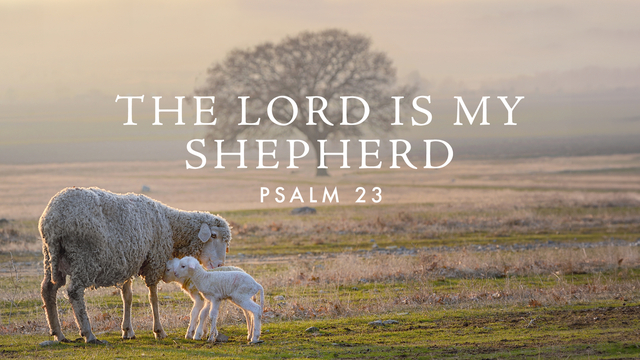
Let’s just think a bit more about the analogy of being like sheep and needing a shepherd. I live in rural Aberdeenshire in Scotland. When I’m on a frequent walk, I will often see a field of sheep. A hallmark of who owns these sheep is usually some sort of tag on the ear or by bright coloured marking on the sheep’s wool.
Now, as you think about whether or not God is LORD of your life, you may like to consider what happened to slaves in the Bible after they decided to stay and be with their master, they were marked by having their ears pierced with an awl and then they would be his servant for life. (Exodus 21:5-6, Deuteronomy 15:16-17).
How do we receive such a mark as to declare to the world that we are under new ownership, and indeed God is our LORD?
Here now is the second part of my brief discourse and might prove to be a difficulty for some Jewish readers.
Some seven hundred and fifty years after Isaiah prophesied the solution to our problem of our iniquity and being like sheep having gone astray would be laid upon someone, well that “someone” was recognised by another prophet, some four hundred years after the book of Malachi, when John Baptist saw Jesus and said, “behold the lamb of God who takes away the sin of the world.” (John 1:29).
It is again beyond coincidence that this person was born in Bethlehem, sheep country, as prophesied in Micah 5:2 and when He came into the world was greeted by shepherds (Luke 2:8-20).
This “person” was of course Jesus, God with us (Isaiah 7:14).
Fast forward to what Jesus said about Himself in John 10:11, “I am the good shepherd. The good shepherd lays down his life for the sheep.”
Please read and take in these amazing verses from John 10:1-17:
“Very truly I tell you Pharisees, anyone who does not enter the sheep pen by the gate, but climbs in by some other way, is a thief and a robber. The one who enters by the gate is the shepherd of the sheep. The gatekeeper opens the gate for him, and the sheep listen to his voice. He calls his own sheep by name and leads them out. When he has brought out all his own, he goes on ahead of them, and his sheep follow him because they know his voice. But they will never follow a stranger; in fact, they will run away from him because they do not recognize a stranger’s voice.” Jesus used this figure of speech, but the Pharisees did not understand what he was telling them.
Therefore, Jesus said again, “Very truly I tell you, I am the gate for the sheep. All who have come before me are thieves and robbers, but the sheep have not listened to them. I am the gate; whoever enters through me will be saved. They will come in and go out, and find pasture. The thief comes only to steal and kill and destroy; I have come that they may have life, and have it to the full.
“I am the good shepherd. The good shepherd lays down his life for the sheep. The hired hand is not the shepherd and does not own the sheep. So when he sees the wolf coming, he abandons the sheep and runs away. Then the wolf attacks the flock and scatters it. The man runs away because he is a hired hand and cares nothing for the sheep.
“I am the good shepherd; I know my sheep and my sheep know me— just as the Father knows me and I know the Father—and I lay down my life for the sheep. I have other sheep that are not of this sheep pen. I must bring them also. They too will listen to my voice, and there shall be one flock and one shepherd. The reason my Father loves me is that I lay down my life—only to take it up again.”
Did you notice verse, “The thief comes only to steal and kill and destroy; I have come that they may have life, and have it to the full.” This means we have a choice to make, don’t we?. Basically, if we choose to be like a sheep going astray and not come into the Shepherds care, we leave ourselves open to suffer the consequences and that will be because of, by default, we come under the control of Satan.
If we accept that our iniquity, our sins, have been paid for by what Jesus did for us on the cross, we will be saved and come under the wonderful and amazing care of the Good Shepherd as outlined in the rest of Psalm 23.
But before I close, earlier I mentioned how a sheep is identified as belonging to the shepherd in some way, usually a tag on the ear, or as shepherds did in those times, marked by a cut on the ear, so we need to bare the mark that we have made the transition from being like sheep gone astray to now belonging to Him, and therefore, we can confidently proclaim, with David, that “The LORD is my shepherd”.
Here then is the mark:
Then Jesus said to his disciples, “Whoever wants to be my disciple must deny themselves and take up their cross and follow me.” (Matthew 16:24)
We are also marked in Him with the seal of the Holy Spirit. (Ephesians 1:13)
Next time I will look at what it means, in the second part of the verse: “I shall not want”.
[1] YHWH is “Yahweh” or also “Jehovah”
